
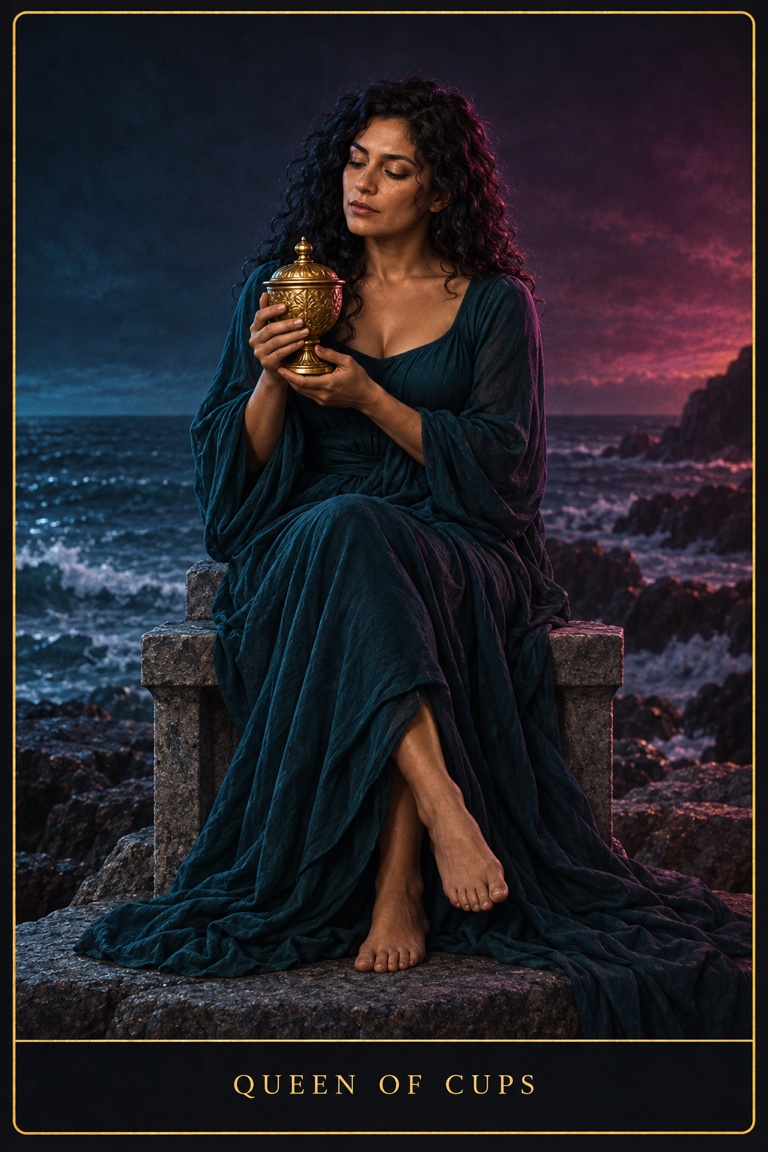
Tarot court cards are the Page, Knight, Queen and King in each of the four suits: sixteen court cards in total. In her court-card lesson, Joan Bunning interprets them through suit and rank and resists limiting them to a fixed age or type of person. They can invite reflection on an approach, rather than identify someone with certainty.
Combine the rank with the suit
Joan Bunning's court-card lesson treats rank and suit as the two parts of an interpretation. Her Pages suggest discovery, Knights can express a suit's qualities to an extreme, Queens express those qualities inwardly, and Kings more outwardly.
These are Bunning's interpretive distinctions. A different deck or reader may use other terms. Begin with the system attached to the reading without assigning the cards a fixed age or gender.
Ask what role the card has in the layout
Before naming a person, check the position. Is the card being read as your approach, a quality you might develop, or part of the atmosphere of a situation? Write that role beside the card.
If your question concerns a conversation with your partner, “What quality could I bring to this exchange?” is different from “Who exactly is this card?” The first can produce a useful reflection without pretending that an illustration identifies somebody's private thoughts.
A worked example about communication
Bunning uses the King of Swords to discuss a fair, clear and carefully considered approach. Here is a hypothetical application to a different situation: you and a partner are deciding when to meet, and you have not explained your availability.
One reflective response is to write down the times you can genuinely offer and ask which works for them. This does not make the King a description of your partner or guarantee agreement. Read our King of Swords page.
Keep identities and interpretations separate
A court card may remind you of someone, but that association is yours to examine. It does not establish their age, gender, fidelity or intentions. A second court card is not evidence of a third person in the relationship.
Read our Page of Cups page for another card in this group. When taking notes, separate “This card makes me think of curiosity” from “They are definitely going to contact me.” The former is an interpretation; the latter is a claim about an event. A useful next step might be a question to ask or a behavior to consider, with room for the real person to surprise you.
Explore your question in a personal reading
For a symbolic perspective on your connection with this person, you can ask a custom question in a Signature Video Reading: “What qualities could I reflect on in my connection with this person?” Koko personally records the reading, starting at $99 for 15+ minutes. Standard delivery is 7–10 days; optional 24-hour Express adds $49.
Read our guide to choosing a love reading. Readings are for entertainment and reflection. They do not establish another person’s thoughts or promise an outcome.